The millions of everyday Brits waking up to a new digital prison


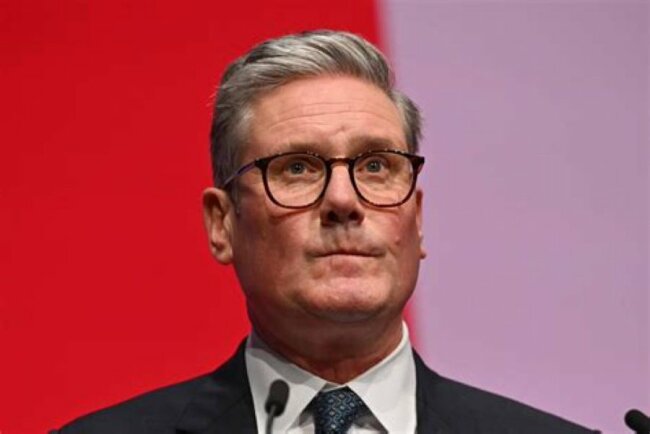
The Starmer regime is banning social media for minors in the UK
Good morning to the millions of everyday Brits waking up to a new digital prison. Elon Musk says UK is a Police state and History will not be kind to Keir Starmer.
Keir Starmer has just officially announced his blanket ban on social media for teenagers! He literally stood at a podium, rambled on about his childhood in the 1970s, and claimed he is doing this to keep your kids safe.
You honestly have to laugh at the sheer delusion. He completely refuses to protect our actual streets from violent criminals, but he is completely obsessed with policing your family's phones. Do not be fooled for a single second! To enforce this ban, every single adult in Britain will now be forced to upload a passport or digital ID just to browse the web! This is not about child safety. It is a massive Trojan horse for total state surveillance. RT if you see right through this scam and refuse to let the Labour elite control us!
"There is no doubt that we are living through an unprecedented age for technological innovation. Artificial intelligence in particular has the power to completely transform our society. It is an opportunity we must take – and we are.
Over half of all European investment in technology last year was into this country. And not just into London – right across Britain, technology firms are taking risks, building the future, creating wealth in their community.
This hasn’t happened by accident. It has happened because the Government has been active. We’ve made decisions to take control of the situation and make sure the economic opportunity of technology works for working people.
This is the point I always make about any issue to do with technology – there are always three choices.
One, you can bury your head, pretend the world isn’t changing and hope for the best. To do this now would obviously be ridiculous, but the long history of British industrial policy shows it’s not as uncommon as it should be!
Two, you can approach it by removing all barriers for the technology firms, never confronting them about any of the challenges, nor trying to direct their activity in any way. This approach too is clearly deficient.
Or three, you can try to harness technology for the good of our country and make sure you are taking decisive action when problems arise.
This is the context for the Government’s decision to ban access to social media for all children under sixteen, which we announced today. It is another example of us taking control of the future and shaping the forces for the benefit of Britain. Because of all the social issues caused new technology, child protection is both the most serious and the most important. I am simply not prepared to be a bystander when the safety and happiness of our children are at stake. And when it comes to social media, that is exactly what the decision is about.
I come at it as a parent, as much as a Prime Minister. My role is no protection for the fears all parents have about social media and dangerous online content. And like any parent, all I want is the best for my kids. For me, hand on heart, that means I just want them to be happy and to be safe – that’s all I’ve ever wanted for them.
But can we really say that social media is currently a happy environment for our children? Can we really say that it is always safe for them? I don’t think so. I think every parent can see, with their own eyes, that the reverse is true: social media is making them unhappy. It is making it easier for bullies – whether at their own school or simply trolling them from thousands of miles away – to harass and abuse them. It is exposing them to content that is dangerous or divisive. It may even be harming their mental health.
It also feels clearly designed to be addictive. Features like the infinite scroll or autoplay videos are designed to lock in your attention for hours. And quite apart from anything more serious or malign, there is an opportunity cost for our children on this. After all, time is precious. Time spent scrolling, is time not spent doing homework, reading, doing something creative, playing with friends outside, or even going to bed at a decent time. These activities may not sound like much, but they are the vital building blocks of a growing personality. Social media threatens all that. It intrudes into ever corner of a child’s life.
To be honest, I feel for children growing up now. We had our problems back in the early 1970s, but there was nothing like this in my childhood. I feel for parents too – it’s hard to know what’s the right thing to do. And all parents put pressure on themselves to do the right thing for their children, so I know how much concern this is causing for parents. That’s why I think they will welcome the clarity and decisiveness of this decision. I think they will welcome having a Government on their side, fighting for the happiness and safety of their children, against some of the most powerful companies in the world.
Of course it won’t be easy. Getting the legislation, the supporting regulation, the proper enforcement process – that is all hard in a technological landscape that moves at such a ferocious pace. But parents should be confident that this ban can be effective for four reasons.
First, we have taken our time to get this right. This decision emerges from a consultation that ran for several months. We have held numerous roundtables with parents, young people and the families of young people who have tragically suffered harm or even loss because of issues to do with social media. Thousands of parents have written into the consultation.
We have looked carefully at other countries going on a similar journey, such as Australia. We have spoken with technical experts. No stone has been left unturned. This is a detailed piece of work, where we have taken seriously the responsibility of Government to listen to the people it serves.
Second, the ban is not in isolation. In fact, in a number of areas, we are going further than a ban. We are cracking down on risky features on gaming sites or livestreaming platforms where, at the moment, strangers can contact any child unchecked. We are looking into device-level controls that would mean no child can use their phone to send a nude image.
And when Grok (the AI feature of the social media platform X) started making nudes of children, women and celebrities without their consent, we challenged X and they backed down. Most of all, this ban builds on the Online Safety Act. That gives us some vital learnings about what does and does not work when it comes to age verification, that we will now apply to this ban.
Third, we have deliberately used a legislative approach that allows us to adapt as technology changes. The enabling powers set out in the Children and Wellbeing Act mean we can move much more quickly and not have to return to primary legislation every time we need to catch-up with new technology.
Fourth, we need to understand that a ban isn’t just a law, it’s also an expression of our values – a norm. This is crucial when it comes to the issue of enforcement. Of course, some children will find a technological work-around. But that doesn’t mean we should not take this step or that it won’t make a difference. We don’t, for example, think it would be sensible to remove the ban on children being able to buy alcohol, just because some teenagers are able to get hold of a few cans of beer. That would be ridiculous. So equally, we should not use total enforcement as the yardstick for success.
The bottom line is that this will change behaviour. Laws are norms too – this will change the discussions parents have with their children and, over time, the expectations of children themselves. It empowers a different kind of conversation in homes across the country.
Ultimately, that is my main hope for this ban – it’s not just about protection. I also hope it will encourage a better childhood, with children using their time in a completely different, dare I say it, more traditional way. That is why, at the same time as the ban, we are also announcing a new round of investment in cultural opportunities for children – in art, music, sport, debating and more. It’s about opportunity.
That, at the end of the day, is what this Government is about. It is why so many of the investments we have made are about young people: in childcare, mental health support, new school-based nurseries, family hubs, tackling child poverty, apprenticeships, technical excellence colleges, special educational needs education, and a youth guarantee that will support every young person who can’t find work with a new opportunity to earn or learn.
They aren’t just policies that aim to fix our problems. They are the building blocks of a completely different Britain. A country where everyone, no matter their background, feels respected for who they are. And where success for our children depends on hard work and their ability. Not their class, their race, or the community they grew up in.
The social media ban is essential for that Britain. It shows that we can harness the opportunities of technology without losing sight of what matters most. It provides our children with the space, time and security to grow up in their own time. And it helps them to become the best version of themselves, able to go as far as their talent will take them.
That is the definition of a Britain built for all."
Keir
**********
Ben Graham: X is banned for under 16s, but Bluesky isn't. X is a platform where people regularly share videos of crime, protests, political scandals and government failures. The other is overwhelmingly left wing and far more sympathetic to the establishment, with no videos of crime, or government failure. Naturally children, who have no other options, are now going to flood onto Bluesky and only see left leaning viewpoints. This is a two tier social media ban.
Jeremy Clarkson : the government’s reported plan to impose a 9pm social media curfew on 16 and 17 yr olds makes no sense. “You don’t trust them to be on social media after 9pm, yet you’re happy for them to vote. How does that work? Am I taking crazy pills?”
No related events
No places assigned
No persons assigned